
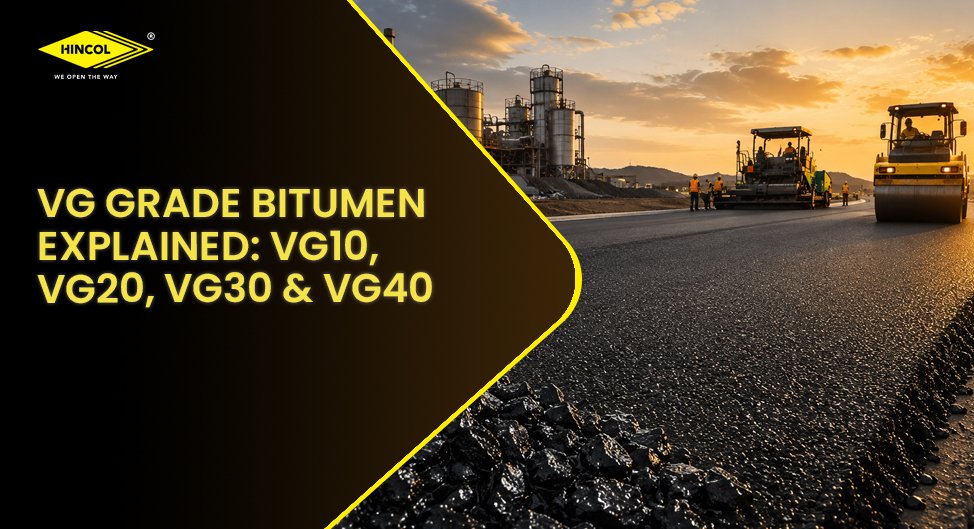
VG Grade Bitumen Explained: VG10, VG20, VG30 & VG40
If you work in road construction, you have seen the labels VG10, VG20, VG30, and VG40. These are viscosity grades of bitumen. Choosing the right one is one of the most important decisions in any paving project.
Pick the wrong grade, and the road may rut in summer or crack in winter. Pick the right grade, and it performs for years. This guide explains what VG grade bitumen means, how the grades differ, and where each one belongs.
What Does “VG” Mean?
VG stands for Viscosity Grade. Viscosity measures how easily a fluid flows. Thick, slow-flowing bitumen has high viscosity. Thinner bitumen has low viscosity.
Older Indian roads used penetration grades. Today the country has moved to the viscosity grading system, which is more scientific and reliable. It is defined under the standard IS 73:2013 by the Bureau of Indian Standards.
The key idea is simple. The grading is based on the viscosity of the bitumen at 60°C, which is close to the maximum temperature a road surface reaches in hot climates.
Why Viscosity Grading Matters
A road faces two enemies: heat and cold.
- In hot weather, soft bitumen can flow and deform, causing rutting.
- In cold weather, hard bitumen can become brittle and crack.
Viscosity grading lets engineers match the bitumen to the local climate and traffic. A higher VG number means a harder, stiffer bitumen that resists heat better. A lower number means a softer bitumen that stays flexible in cold.
The Four VG Grades Explained
Let us break down each grade and where it fits.
VG10 — The Softest Grade
VG10 is the softest and most fluid. It is mainly used for:
- Spray applications and surface dressing
- Making bitumen emulsions and cutback bitumen
- Cold regions and hilly areas like the Himalayas
- Low-traffic roads
Its low viscosity makes it easy to spray and work with in cold conditions.
VG20 — The Least Common Grade
VG20 sits between VG10 and VG30. It is used in colder, high-altitude regions of India for paving. In practice it is the least commonly produced grade, because VG10 and VG30 cover most needs.
VG30 — The Workhorse Grade
VG30 is by far the most widely used grade in India. It is the default choice for:
- National and state highways
- Heavily trafficked urban roads
- Dense Bituminous Macadam (DBM) and Bituminous Concrete (BC)
VG30 offers a strong balance of heat resistance and flexibility, which suits most of India’s plains and moderate climates. If a project does not specify otherwise, it usually means VG30.
VG40 — The Toughest Grade
VG40 is the hardest, highest-viscosity grade. It is designed for the most demanding conditions:
- High-stress areas like toll plazas and intersections
- Roads with very heavy or slow-moving traffic
- Extremely hot regions
- Expressways carrying container and truck traffic
Because it resists deformation so well, VG40 is chosen where rutting is a serious risk. High-performance corridors like the Samruddhi Mahamarg rely on grades like VG30 and VG40.
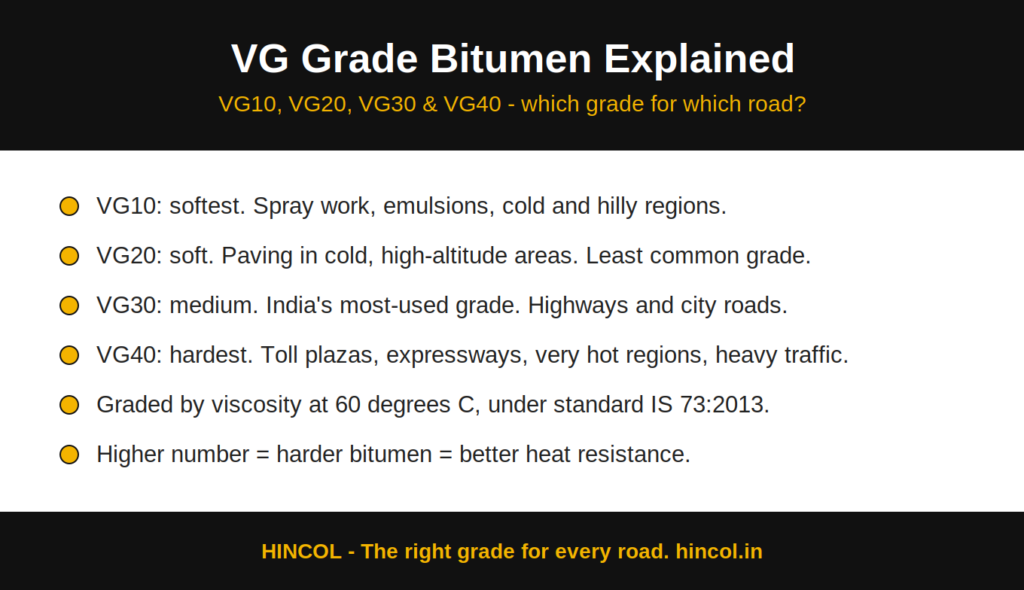
VG Grade Comparison at a Glance
| Grade | Hardness | Best For | Climate |
| VG10 | Softest | Spray, emulsions, surface dressing | Cold / hilly |
| VG20 | Soft | Paving in cold regions | Cold / high altitude |
| VG30 | Medium | Highways, city roads (most common) | Moderate / hot plains |
| VG40 | Hardest | Toll plazas, expressways, heavy traffic | Very hot / high stress |
How to Choose the Right VG Grade
Follow these practical steps:
- Check the climate. Hot region? Lean toward VG30 or VG40. Cold region? VG10 or VG20.
- Assess the traffic. Heavier and slower traffic needs a higher grade.
- Match the specification. MoRTH and IRC specifications for the project usually state the grade.
- Consider modification. For the most extreme conditions, a modified grade like PMB or CRMB may outperform even VG40.
When plain VG grades are not enough, modified bitumen becomes the better answer.
VG Grade vs Modified Bitumen
VG grades are excellent for standard roads. But on expressways, high-temperature zones, or heavy-traffic corridors, engineers often move to modified bitumen. PMB and CRMB add polymers or rubber to push performance well beyond what VG40 can offer. The trade-off is higher cost, justified on high-value roads.
Quality and Testing
Every VG grade must pass a series of tests before use. These include penetration, softening point, ductility, and viscosity tests. These confirm the bitumen meets IS 73:2013. A reliable supplier tests every batch and provides certification. This is central to how HINCOL manages quality — see how bitumen is made and our about page.
Conclusion
VG grade bitumen is the foundation of modern Indian roads. VG10 for cold and spray work, VG30 as the everyday workhorse, and VG40 for the toughest conditions. Understanding these grades helps engineers, contractors, and buyers make the right call.
The rule is simple. Match the grade to the climate and the traffic, and back it with proper testing.
Looking for reliable VG grade bitumen?
Explore HINCOL’s complete bitumen range or get in touch for the right grade for your project.