
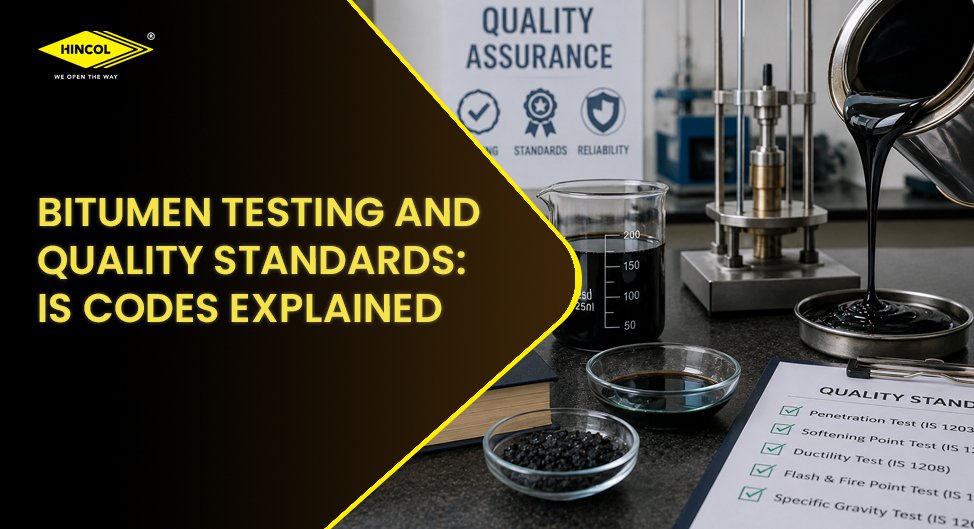
Bitumen Testing and Quality Standards: IS Codes Explained
A road is only as good as the bitumen that binds it. Poor-quality bitumen leads to rutting, cracking, and early failure. That is why bitumen testing is not optional. It is the safeguard that protects every road investment.
This guide explains the key bitumen tests, the Indian standards that govern them, and why quality control matters so much. Whether you are a contractor, engineer, or buyer, understanding these basics helps you demand and verify quality.
Why Bitumen Testing Matters
Bitumen is a natural product refined from crude oil. Its properties vary depending on the crude source and refining process. Testing ensures the bitumen meets the exact specifications a road needs.
Without proper testing, you cannot be sure the bitumen will:
- Withstand the local climate
- Handle the expected traffic
- Bond properly with aggregate
- Last for its designed life
A single batch of substandard bitumen can compromise an entire road. Testing removes that risk.
Who Sets the Standards?
In India, bitumen quality is governed by several bodies:
- **Bureau of Indian Standards (BIS).** Sets the IS codes for bitumen products.
- Indian Roads Congress (IRC). Provides road construction specifications.
- **Ministry of Road Transport and Highways (MoRTH).** Issues the specifications for highway works.
Together, these define what “good bitumen” means and how to verify it.
Key Indian Standards for Bitumen
Here are the main IS codes you should know:
- IS 73:2013 — Paving grade bitumen (VG10, VG20, VG30, VG40).
- IS 8887 — Bitumen emulsions.
- IS 15462 — Polymer and rubber modified bitumen.
- IS 217 — Cutback bitumen.
Each standard lays out the required properties and the test methods to confirm them.
The Essential Bitumen Tests
Several tests together build a complete picture of bitumen quality. Here are the most important ones.
1. Penetration Test
This measures hardness. A standard needle is allowed to penetrate the bitumen under set conditions. Deeper penetration means softer bitumen. It is one of the oldest and most basic tests.
2. Softening Point Test
This finds the temperature at which bitumen softens. A higher softening point means better resistance to hot weather. The ring-and-ball method is used. It is vital for choosing bitumen for hot climates.
3. Ductility Test
This measures how far bitumen can stretch before breaking. Good ductility means the bitumen is elastic and resists cracking. Brittle bitumen fails this test.
4. Viscosity Test
This measures how easily the bitumen flows at a given temperature. Viscosity grading (the VG system) is based on this test. It confirms the grade of the bitumen.
5. Flash Point Test
This finds the temperature at which bitumen gives off flammable vapours. It is a crucial safety test for handling and heating.
6. Specific Gravity Test
This checks the density of the bitumen, helping confirm purity and consistency.
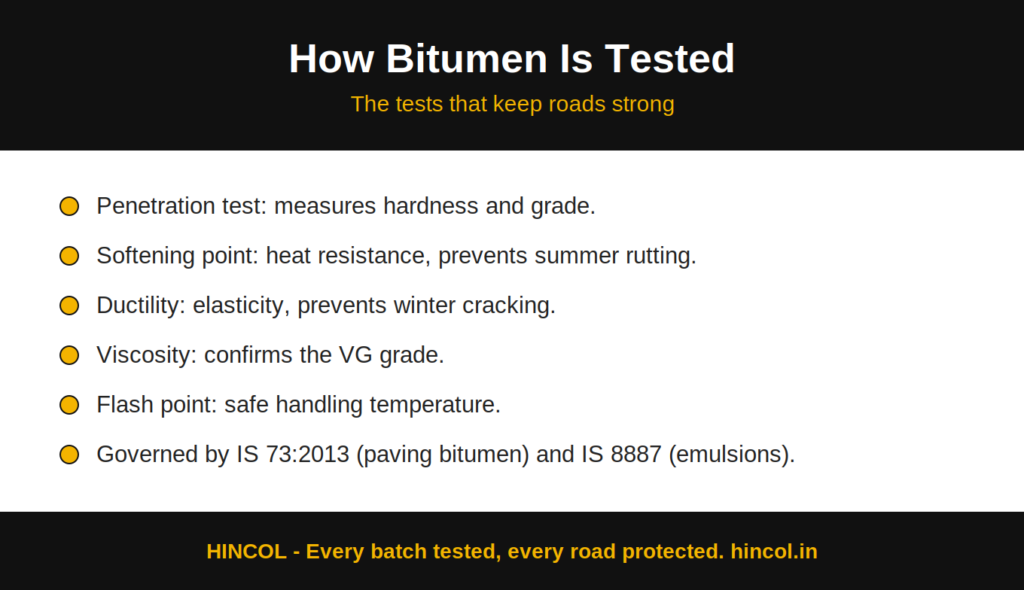
Tests at a Glance
| Test | What It Measures | Why It Matters |
| Penetration | Hardness | Grade and consistency |
| Softening point | Heat resistance | Performance in hot climates |
| Ductility | Elasticity | Crack resistance |
| Viscosity | Flow | Confirms VG grade |
| Flash point | Safety temperature | Safe handling |
| Specific gravity | Density | Purity check |
How Testing Protects Your Road
Each test guards against a specific failure:
- Softening point testing prevents rutting in summer.
- Ductility testing prevents cracking in winter.
- Viscosity testing ensures the right grade is used.
- Flash point testing keeps workers safe.
Together they ensure the bitumen is fit for purpose before it ever reaches the road.
Quality Control at a Trusted Manufacturer
Reputable manufacturers test every batch, not just samples. This is the difference between reliable and risky supply. A good supplier provides test certificates confirming compliance with the relevant IS codes.
At HINCOL, quality control runs through the entire process, backed by refinery-grade supply and strict testing. Learn more about how bitumen is made and about HINCOL. This commitment ensures our bitumen products, including polymer modified bitumen, meet exacting standards.
What Buyers Should Ask For
When buying bitumen, protect yourself by asking:
- Which IS standard does the product meet?
- Can you provide a batch test certificate?
- What grade is it, and is it verified by testing?
- How is quality controlled during production?
A trustworthy supplier will answer all of these clearly. If they cannot, that is a warning sign.
Quality Checks Before the Construction Season
With the monsoon ending, road work across India is about to pick up pace. This is the right time to tighten quality checks on incoming bitumen so that problems are caught at the gate, not on the finished road.
Check the test certificate with every load: Each consignment should come with a test certificate showing the grade and key results such as viscosity, penetration and softening point. Compare these against the requirements of the relevant IS specification.
Sample correctly: Take representative samples as per the standard sampling procedure and keep a retained sample from each batch. A poor sample can make good bitumen look bad, or hide a real problem.
Run quick site tests: Penetration and softening point tests are fast and can flag grade mix-ups or overheated material before it is used.
Control storage temperature: Overheating bitumen in storage tanks ages the binder and reduces its life. Keep temperatures within the supplier’s recommended range and avoid holding hot material for long periods.
Keep records: Log batch numbers, test results and where each lot was used. Good records make it much easier to trace and solve any pavement failure later.
Conclusion
Bitumen testing is the invisible guardian of road quality. Through penetration, softening point, ductility, viscosity, and other tests, it ensures the bitumen can handle India’s climate and traffic.
Backed by IS standards like IS 73:2013 and IS 8887, proper testing protects road investments worth crores. For buyers, insisting on tested, certified bitumen is the simplest way to ensure lasting roads.
Want quality-assured bitumen you can trust?
Explore HINCOL’s tested bitumen product range or contact us for certified supply.