

Driving Sustainability and Performance: Crumb Rubber Modified Bitumen by HINCOL for Roads That Last.
Crumb Rubber Modified Bitumen (CRMB) is an innovative and sustainable solution that enhances the properties of conventional bitumen by incorporating recycled rubber granules obtained from end-of-life tires. This eco-friendly approach not only helps in recycling waste rubber but also improves the performance and durability of bitumen in road construction projects.

Select Grade
Quantity
Min 1
Inquiry Sent!
Our CRMB specialist will respond within 1 business day.
HINCOL CRMB | Crumb Rubber Modified Bitumen Manufacturer & Supplier India
HINCOL CRMB (Crumb Rubber Modified Bitumen) is a premium value-added bitumen by Hindustan Colas Limited — produced by blending viscosity-grade refinery bitumen with recycled crumb rubber from end-of-life tyres and special hydrocarbon additives. Strictly manufactured as per IS 15462:2004 and IRC SP 53-2002. No heating required. Superior rutting resistance, fatigue life, and skid resistance — the preferred binder for expressways, airport runways, bridges, and flyovers across India.
CRMB 50 / 55 / 60
:2004BIS Standard Compliance
× COLASJV — Global Expertise
Choose the Right CRMB Grade for Your Region
CRMB 50 — Cold Climate
Softening Point ≥ 50°CFor snow-bound areas, high-altitude mountain highways, and frost-prone zones — J&K, Himachal Pradesh, Uttarakhand, Northeast India.

CRMB 55 — Moderate Climate
Softening Point ≥ 55°CMost widely used grade in India — state highways, national highways, flyovers, bridges, and urban expressways across most Indian states.

CRMB 60 — Hot Climate
Softening Point ≥ 60°CMaximum rutting resistance for Rajasthan, Gujarat, AP, Maharashtra — airport runways, expressways, bus lanes, industrial platforms.
| Property | CRMB 50 | CRMB 55 | CRMB 60 | Test Method |
|---|---|---|---|---|
| Penetration at 25°C, 0.1 mm (max) | <70 | <60 | <50 | IS 1203-1978 |
| Softening Point (R&B), °C (min) | 50 | 55 | 60 | IS 1205-1978 |
| Elastic Recovery (half thread, 15°C) % (min) | 50 | 50 | 50 | IS 15462-2004 |
| Flash Point, °C (min) | 220 | 220 | 220 | IS 1209-1978 |
| Separation — Diff. in Softening Point, °C (max) | 4 | 4 | 4 | IS 15462-2004 |
| THIN FILM OVEN TEST (TFOT) ON RESIDUE | ||||
| a. Penetration of residue at 25°C, % of original (min) | 60 | 60 | 60 | IS 1203-1978 |
| b. Increase in Softening Point, °C (max) | 7 | 6 | 5 | IS 1205-1978 |
| c. Elastic Recovery (half thread, 25°C) % (min) | 35 | 35 | 35 | IS 15462-2004 |
All values as per IS 15462:2019 and IRC SP 53-2002.
Recommended Application Temperatures
| Process | Temperature Range |
|---|---|
| ▶ Mixing with Aggregates / Coating | 170 – 185°C |
| ▶ Laying | 150 – 170°C |
| ▶ Beginning of Compaction | Over 140°C |
| ▶ End of Compaction | 110 – 120°C |
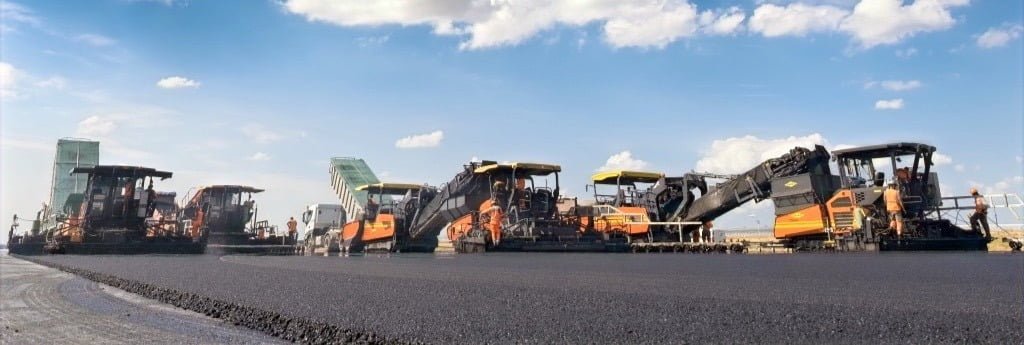
HINCOL CRMB for Every Stage of Heavy Pavement
CRMB is used at the critical wearing course stage — the final layer that takes the brunt of traffic, weather, and heavy loads.
Subgrade
Earth foundation of the road
Granular Base (WMM)
Prime coat seals base before surfacing
Tack Coat
Bonds asphalt layers together
DBM / Base Course
Dense bituminous macadam layer
CRMB
CRMB used here — BC / SDBC
SAMI Layer
CRMB for stress-absorbing interlayer on bridges
Heavy Traffic Highways
National highways, expressways, and bus lanes where rutting and fatigue are critical.
Airport Runways & Aprons
Runways, taxiways, and parking aprons — extreme load capacity and skid resistance.
Bridges & Flyovers
SAMI (Stress Absorbing Membrane Interlayer) on bridge decks prevents reflective cracking.
Slopes, Roundabouts & Junctions
High slow-moving vehicle loads requiring maximum deformation resistance.
Industrial & Multimodal Platforms
Container terminals, logistics parks with very high concentrated axle loads.
Snow-Bound & High Rainfall Regions
Mountain highways and snow-bound roads — CRMB 50 for flexibility and water resistance.
Waterproofing Concrete Structures
Waterproofing of concrete bridge decks, rooftops, and structures.
Acoustic & Thin Overlay
Porous asphalt and acoustic thin overlays to reduce traffic noise in urban areas.
Bus & Truck Parking
Bus stations and truck terminals where stationary loads cause deformation in standard bitumen.
Related HINCOL Bitumen Products
Frequently Asked Questions — CRMB Bitumen
What is CRMB full form in road construction?
CRMB full form is Crumb Rubber Modified Bitumen. In road construction, CRMB is a premium binder produced by blending viscosity-grade bitumen with crumb rubber from end-of-life tyres and special additives. It delivers superior rutting resistance, elasticity, and fatigue life vs conventional VG bitumen. Governed by IS 15462:2004 and IRC SP 53-2002 in India.
What is the IS code for CRMB?
The IS code for CRMB is IS 15462:2004 — Polymer and Rubber Modified Bitumen Specification. Additionally, IRC SP 53-2002 governs CRMB use on Indian roads. HINCOL CRMB strictly conforms to both IS 15462:2019 and IRC SP 53-2002.
What is the difference between CRMB 50, CRMB 55, and CRMB 60?
Primary difference is softening point and climatic zone:
- CRMB 50 — SP ≥ 50°C — cold climatic areas (J&K, Himachal, Uttarakhand)
- CRMB 55 — SP ≥ 55°C — moderate climatic areas (most Indian states)
- CRMB 60 — SP ≥ 60°C — hot climatic areas (Rajasthan, Gujarat, AP)
All three grades: Elastic Recovery ≥ 50% at 15°C, Flash Point ≥ 220°C, TFOT Residue ER ≥ 35%.
What is CRMB 60 bitumen and where is it used?
CRMB 60 is the hot-climate grade with minimum softening point 60°C. Recommended for Rajasthan, Gujarat, Maharashtra, AP, Telangana, Karnataka where summer pavement temperatures exceed 60–70°C. Used on national highways, expressways, airport runways, industrial roads, and bus lanes requiring maximum rutting resistance.
What is CRMB 55 bitumen used for?
CRMB 55 is the moderate-climate grade with minimum softening point 55°C — the most widely used CRMB grade in India. Suitable for state highways, national highways, urban expressways, flyovers, bridges, and roundabouts across most Indian states. Provides optimal balance between rutting resistance and flexibility.
What is rubber modified bitumen?
Rubber modified bitumen (CRMB) is bitumen enhanced by incorporating crumb rubber from recycled end-of-life tyres. The rubber modifies bitumen’s stiffness, elasticity, and viscosity — making it resistant to temperature variations, rutting, and fatigue cracking. Governed by IS 15462:2004 in India.
How is CRMB different from PMB (Polymer Modified Bitumen)?
Who are CRMB manufacturers and suppliers in India?
Hindustan Colas Limited (HINCOL) is a leading CRMB manufacturer and supplier in India — a JV between HPCL and COLAS S.A. France. Plants across India for immediate supply of CRMB in Bulk, and MS Drums (200 Kg) to highway contractors, NHAI, state PWD, and airport authorities pan-India.
What is CRMB bitumen specification for tender / procurement?
CRMB specification per IS 15462:2004: Penetration at 25°C — <70/<60/<50 (CRMB 50/55/60); SP min — 50/55/60°C; Elastic Recovery at 15°C min — 50%; Flash Point min — 220°C; Separation max — 4°C; TFOT Residue Penetration min — 60%; TFOT Residue SP increase max — 7/6/5°C; TFOT Residue Elastic Recovery at 25°C min — 35%. Test Methods: IS 1203-1978, IS 1205-1978, IS 15462-2004, IS 1209-1978.
Manufactured to the Highest Standards
Every HINCOL CRMB batch is tested in our NABL-accredited laboratories before dispatch. Quality checks cover penetration, softening point, elastic recovery, flash point, and separation — every batch. Our IS 15462:2019 and IRC SP 53-2002 compliant manufacturing is certified under ISO 9001:2015.
Backed by COLAS SA France — global leader in road construction with operations in 50+ countries — HINCOL brings world-class modified bitumen technology to Indian road builders.