
PMB vs CRMB: Which Modified Bitumen Is Right for Your Road?
Standard bitumen works well for ordinary roads. But expressways, high-traffic corridors, and extreme climates demand more. That is where modified bitumen comes in.
The two most popular modified bitumen types in India are PMB and CRMB. Both outperform plain bitumen. But they work differently, cost differently, and suit different projects.
This guide compares PMB vs CRMB clearly, so you can choose the right one.
What Is Modified Bitumen?
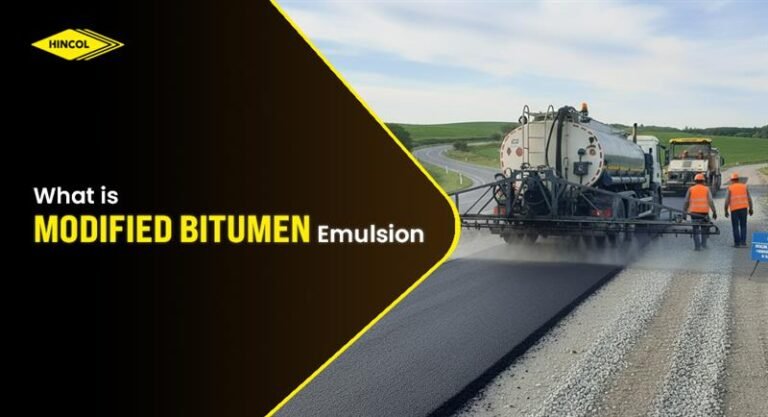
Modified bitumen is regular bitumen with an additive blended in to improve performance. The additive makes the bitumen tougher, more elastic, and more resistant to heat and heavy loads.
The result is a road that lasts longer, resists rutting, and handles stress better. For high-value roads, this extra durability easily justifies the higher cost. Learn more on our modified bitumen page.
What Is PMB (Polymer Modified Bitumen)?
PMB is bitumen modified with polymers. The most common polymers are SBS (an elastomer) and EVA or plastomers. These polymers form a network inside the bitumen that boosts elasticity and strength.
Key benefits of PMB:
- Excellent resistance to rutting in hot weather
- Better flexibility and crack resistance in cold
- Longer fatigue life under repeated loading
- Strong performance on heavy-traffic roads
PMB is the go-to choice for national highways, expressways, and airport runways. Read more on our polymer modified bitumen page and our explainer on what polymer modified bitumen is.
What Is CRMB (Crumb Rubber Modified Bitumen)?
CRMB is bitumen modified with crumb rubber, made from recycled tyres. The rubber is ground into fine crumbs and blended into the hot bitumen.
Key benefits of CRMB:
- Good resistance to rutting and cracking
- Reduced road noise
- Lower cost than PMB in many cases
- Environmentally friendly, since it reuses waste tyres
CRMB is popular for highways and urban roads where durability and cost both matter. It also supports India’s sustainability goals by consuming waste tyres. Explore our crumb rubber modified bitumen range.
PMB vs CRMB: Side-by-Side Comparison
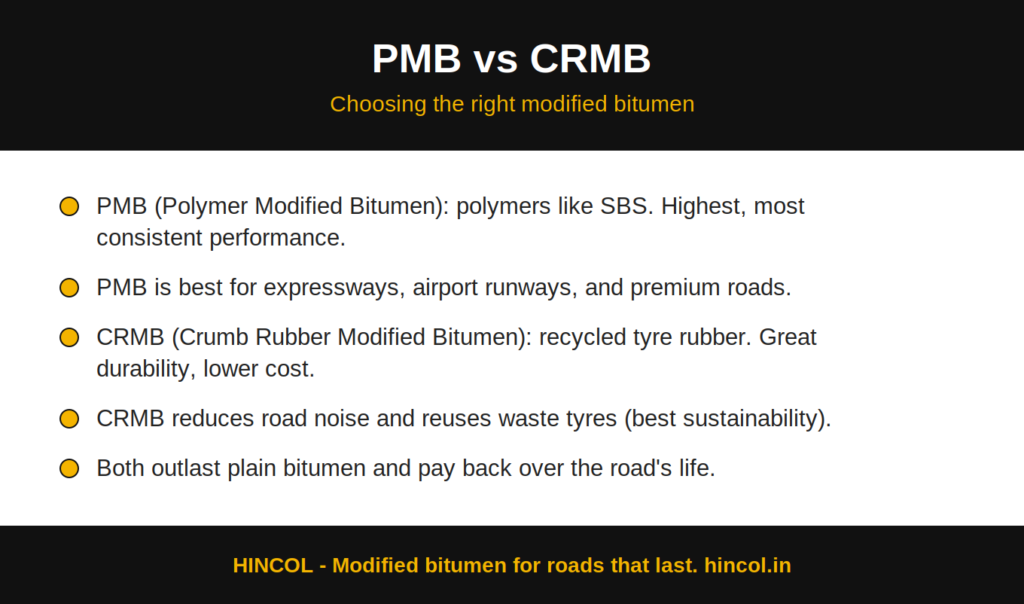
| Factor | PMB | CRMB |
| Modifier | Polymers (SBS, EVA) | Recycled tyre rubber |
| Performance | Highest, most consistent | Very good |
| Cost | Higher | Usually lower |
| Elasticity | Excellent | Good |
| Noise reduction | Moderate | Better |
| Sustainability | Good | Excellent (reuses tyres) |
| Best for | Expressways, runways, premium roads | Highways, urban roads, cost-sensitive projects |
Performance: Which One Wins?
On pure performance and consistency, PMB usually leads. Its polymer network gives predictable, high-end results, which is why premium projects specify it.
CRMB is not far behind. It delivers strong durability and adds noise reduction, all at a friendlier price. For many highway and city projects, CRMB offers the best value.
The honest answer is that neither is universally “better.” The right choice depends on the project.
Cost Considerations
PMB generally costs more because polymers are expensive and the blending is precise. CRMB often costs less because crumb rubber is a recycled, lower-cost input.
But cost should be judged over the road’s life, not just at purchase. A modified bitumen road that lasts far longer than a plain bitumen road saves money on repairs and rebuilding. Both PMB and CRMB pay back their premium through longer life.
Sustainability Angle
CRMB has a clear environmental edge. Every tonne of CRMB consumes waste tyres that would otherwise pollute. With India generating huge volumes of end-of-life tyres, CRMB turns a waste problem into a road-building resource.
PMB is also improving, with newer formulations and recycled-content options emerging. For projects with green targets, CRMB is often the natural fit. See HINCOL’s responsible commitment to sustainability.
How to Choose Between PMB and CRMB
Use these guidelines:
- Choose PMB for expressways, airport runways, premium corridors, and the most demanding climates, where top performance justifies the cost.
- Choose CRMB for highways and urban roads where you want strong durability, noise reduction, and sustainability at a better price.
- Check the specification. MoRTH and IRC guidelines for your project may already state which to use.
- Ask a specialist. A manufacturer like HINCOL can advise based on your traffic, climate, and budget.
For unusual requirements, special products may offer an even better tailored solution.
Conclusion
Both PMB and CRMB take road performance well beyond plain bitumen. PMB delivers premium, consistent results for the most demanding roads. CRMB offers excellent value and sustainability for highways and city roads.
There is no single winner. The best modified bitumen is the one matched to your project’s traffic, climate, budget, and environmental goals.
Not sure which modified bitumen you need?
Compare HINCOL’s PMB and CRMB ranges, or contact our experts for advice.