
How Bitumen is Made: The Complete Refinery Process Explained
Bitumen (also called asphalt binder) is a thick, black petroleum residue widely used in road paving and waterproofing. It can occur naturally (e.g. Trinidad’s Pitch Lake) or be produced in refineries by distilling crude oil. In refineries, bitumen is the heavy fraction left after crude oil has been distilled. This heavy “bottom” fraction (with boiling point ≳500 °C) is further treated to achieve the desired hardness and consistency. In this guide we explain step-by-step how bitumen is made – from crude oil feedstock to finished bitumen – and also cover its uses, environmental impact, and new bio-based alternatives.
What Is Bitumen?
Bitumen is a viscous, black semi-solid mixture of high‑molecular-weight hydrocarbons (mainly asphaltenes and maltenes) derived from petroleum. It behaves like a very thick liquid that softens when heated and hardens when cooled. In practice, “bitumen” and “asphalt” are often used interchangeably (especially in American English). About 70% of bitumen production is used in road construction. In asphalt concrete, bitumen acts as a binder (glue) that holds 95% aggregate (stones, sand) together. The rest (~10%) of bitumen is used in roofing materials (roof felt, shingles) and other building products (sealants, paints, waterproofing).
Bitumen terminology: The raw product from distilling crude is sometimes called straight-run bitumen. It can be further processed or “blown” with air to make oxidized bitumen (used for roofing). Bitumen should not be confused with coal tar or coal-tar pitch – those are different substances produced by pyrolysis of coal.
Sources of Bitumen (Natural and Refined)
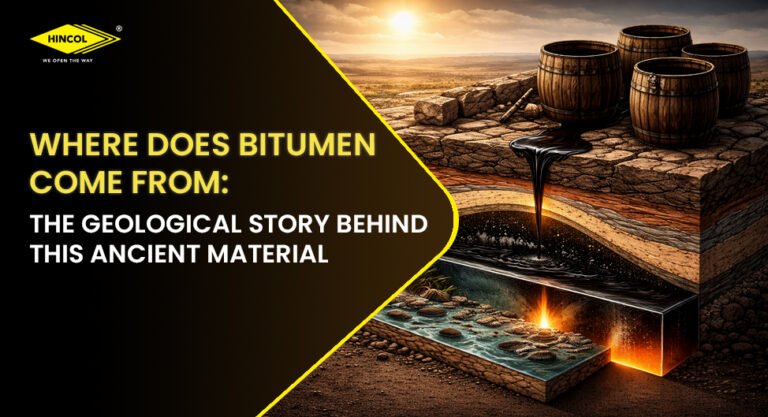
Bitumen originates either from naturally occurring deposits or as a refined petroleum product. Geological deposits of native bitumen (often called “pitch”) occur in places like Trinidad’s Pitch Lake and Canada’s oil sands. However, most commercial bitumen is produced in oil refineries. It is obtained as the heavy residue of crude oil after distillation. During distillation, light components (gasoline, kerosene, diesel) boil off, leaving the very heavy, high-boiling oil at the bottom of the tower. This bottom fraction (>500 °C) is essentially crude bitumen.
Refineries often blend or select crude oils rich in heavy molecules (specific gravity >0.9) to maximize bitumen yield. Some countries (e.g. Venezuela’s Orinoco Belt, Canada’s Athabasca region) produce large volumes of natural bitumen, which may be upgraded or diluted for transport. The heavy oil from oil sands is a prime feedstock: Canada’s oil sands contain an estimated 310 billion barrels of bitumen. In summary, bitumen comes from the densest fractions of petroleum – either mined (oil sands) or recovered by refining crude oil.
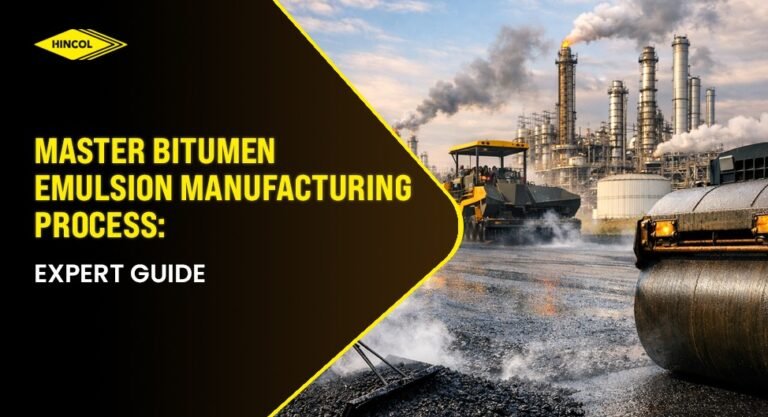
Bitumen is extracted in refineries using a two-stage distillation process. First, atmospheric distillation boils off gasoline and diesel. The heavy residue (called “long residue”) is then sent to a vacuum distillation unit. Under reduced pressure, more oil is vaporized, leaving an even heavier “short residue” or vacuum bottom. This vacuum bottom is essentially crude bitumen.
Bitumen Production Processes
After distillation, the crude bitumen residue may still need processing to meet specifications. There are four main refining methods to produce bitumen with desired properties:
- Straight-Run (Residue) Bitumen: In some cases the vacuum bottom is already sufficiently viscous and penetration-rated to use directly as bitumen (especially for road paving). This is called straight-run bitumen. If its softening point and penetration are adequate (usually 35–300 dmm), it may be shipped as-is.
- Air Blowing (Oxidation): The most common method is air blowing, which hardens the bitumen. Hot bitumen residue is pumped into a “blowing tower” and compressed air is bubbled through it. Oxygen from the air oxidizes hydrocarbons, causing polymerization and loss of hydrogen. This increases the asphaltene content and raises the softening point, producing oxidized bitumen. Semi-automatic or fully automated processes control temperature (typically 250–300 °C) and duration (3–24+ hours) to reach the target grade. Fully blown bitumen is much harder and is often used in roofing and industrial applications.
- Solvent Deasphalting: In this method, the vacuum residue is mixed with a light paraffinic solvent (propane or butane) in a deasphalting unit. The solvent dissolves lighter oils and maltenes, which are separated out, leaving behind a reduced volume of very heavy asphaltene-rich bitumen. Solvent-deasphalted bitumen tends to have lower viscosity, higher ductility, and better temperature resistance than conventional bitumen. This method is often used for crudes low in heavy molecules, to produce a purer bitumen product.
- Blending: Bitumen may also be made by blending different grades of bitumen or residues to achieve a specific quality. For example, a 40/50 penetration bitumen can be mixed with a 200/300 grade to attain an intermediate 80/100 penetration grade. Blending is not a primary production step, but a way to fine-tune properties without further chemical processing.
In modern refineries these steps may all be present. A typical step-by-step process is:
- Crude Oil Distillation: Heat crude in an atmospheric distillation tower; light products boil off and are collected. The bottom atmospheric residue (long residue) remains.
- Vacuum Distillation: The atmospheric residue is vacuum distilled. Lower pressure allows more material to vaporize, yielding additional fuels and leaving the vacuum bottoms (short residue).
- Bitumen Blowing: Optionally, the short residue is passed to a blowing tower where air is injected. This oxidizes the bitumen, increasing stiffness and softening point. The result is oxidized (or “blown”) bitumen suited for high-temperature or waterproofing uses.
- Solvent Deasphalting (Optional): Some refineries dissolve the short residue in propane/butane. The solvent extracts lighter fractions, and the remaining heavy asphaltenes form a high-grade bitumen.
- Polymer Modification (Optional): For enhanced road performance, polymers (SBS, EVA, etc.) are blended into bitumen to make polymer-modified bitumen (PMB).
Each of these steps is closely controlled and followed by quality testing. Because bitumen must meet strict standards, refineries perform tests like penetration, softening point, ductility and viscosity on each batch.
Key Chemical Changes
During air blowing, oxygen atoms chemically alter the hydrocarbons in bitumen. They create new carbon-carbon bonds (polymerization) and form esters, increasing molecular weight. Hydrogen is stripped away (dehydrogenation), forming rings and unsaturated structures. Overall, oxidation produces more asphaltenes and resins, reducing penetration and raising softening point. Cooling jackets are used in the blowing tower to dissipate exothermic heat and maintain constant temperature. In semi-continuous blowing, batches of hot bitumen are treated, whereas continuous blowing feeds bitumen steadily through the reactor.
In solvent deasphalting, the feed bitumen is diluted and separated: propane (or butane) dissolves saturates and aromatics, which can be recovered as de-asphalted oil. The remaining undissolved fraction (asphaltenes) is reclaimed as premium bitumen. This method effectively removes some of the lighter oils, concentrating the heaviest material into the product bitumen.
Types of Bitumen Products
Refinery processes yield several commercial bitumen products:
- Paving Grade Bitumen: Known by penetration grades (PEN 60/70, 80/100, etc.), used primarily in road asphalt. This is generally straight-run or lightly blown bitumen.
- Oxidized (Blown) Bitumen: Produced by heavy air blowing. Hard and high-softening-point, it’s used in roofing membranes, waterproofing, and industrial flooring.
- Cutback Bitumen: Bitumen dissolved in petroleum solvents (kerosene, diesel) to lower its viscosity for cold application. The solvent evaporates after laying.
- Emulsion Bitumen: Bitumen dispersed in water with emulsifiers. Because it flows at lower temperature, it is used in cold-mix asphalt and surface treatments. (See sidebar below.)
- Polymer-Modified Bitumen (PMB): Bitumen blended with polymers (e.g. styrene-butadiene) to improve elasticity and temperature range. Used in high-performance and extreme-climate pavements.
Applications of Bitumen
Bitumen’s primary use is as the binder in asphalt concrete for paving roads, highways, parking lots and airport runways. Worldwide, roughly 70–85% of bitumen is used for asphalt pavements. Typical asphalt concrete is about 5% bitumen and 95% mineral aggregate. For example, a concrete mix for a highway might use only 5 kg of bitumen per 100 kg of aggregate. Bitumen’s adhesive and waterproofing properties make it ideal to bind rocks together into durable pavement.
The remaining ~10–15% of bitumen production goes into construction and industrial uses. About 10% of bitumen is used in roofing materials – as waterproofing felts, shingles and membranes. The last ~5% is used in a variety of applications: pipe coatings, carpet backings, adhesives, paints, sealants and asphalt emulsions. For instance, polymer-modified bitumen is used for bridge decks and heavy-duty pavements, while cutback bitumen is used in road maintenance. Bitumen also binds aggregates in stone mastic asphalt for bridges and tunnels. Its impermeability makes it useful in dam and embankment construction too.
Bitumen Emulsions (Cold Asphalt)
Bitumen emulsions are a special form of bitumen product made by mixing bitumen, water, and an emulsifier agent. Because water is the carrier, emulsions flow at ambient temperature, making them useful for cold-mix asphalt and surface treatments. Forming a bitumen emulsion is non-trivial: bitumen and water won’t mix by simple stirring. Emulsifiers (soap-like molecules) are added so that tiny droplets of bitumen stay dispersed in water. In practice, a colloid mill or a High Internal Phase Ratio (HIPR) unit is used: molten bitumen and a water-emulsifier mix are sheared at high speed to produce micron-sized droplets coated with surfactant.
Once applied to aggregates or pavement, the emulsion “breaks” – the bitumen droplets coalesce and the water evaporates, leaving a film of asphalt on the stones. Emulsions are very useful in road repair because they require no heating and pose less fire risk. They are widely used for chip seals, slurry seals, cold-mix asphalt and rejuvenating recycled asphalt pavement.
Environmental Impacts and Bio-Alternatives
Bitumen production and use have environmental considerations. Producing bitumen involves high-temperature processes and generates CO₂ and other emissions. On the upside, bitumen is highly recyclable: reclaimed asphalt pavement (RAP) from old roads can be reheated and reused, often replacing 20–30% of new bitumen in a mix. Modern plants also seek to reduce energy use (e.g. warm-mix asphalt technologies) and limit emissions.
A significant concern is that paved asphalt surfaces emit volatile organic compounds (VOCs) into the air, especially on hot, sunny days. Recent studies show asphalt can generate complex organic pollutant mixtures under sunlight, contributing to urban air pollution (secondary organic aerosols) at levels comparable to vehicle emissions. This has spurred interest in “cooler” pavement surfaces and alternative binders.
One approach is bio-bitumen, which replaces some petroleum bitumen with renewable materials. Research has demonstrated using lignin (a woody polymer byproduct) to make asphalt binder. For example, Dutch experiments paved test roads using a 50/50 blend of lignin and petroleum bitumen, with performance similar to conventional asphalt. Other efforts use waste oil and biomass pyrolysis: pyrolyzing household or agricultural waste at ~500 °C in the absence of oxygen yields a black liquid with properties like bitumen. These bio-based binders can often be mixed with standard bitumen or polymers to meet road standards.
Bitumen can also be made from non-petroleum sources by refinery-like processes. For instance, sugar, molasses or starches can be polymerized into a pitch-like product. Even waste motor oil can be fractionally distilled to produce bitumen. Though currently more expensive, such alternatives are being pursued to reduce reliance on crude oil. The industry also explores using lighter-colored binders (e.g. white bitumen) to lower urban heat island effects.
Overall, the bitumen industry is large: about 100–160 million tonnes of bitumen are produced worldwide each year (around 15 million in the EU). There is growing emphasis on sustainability: reducing emissions, recycling old asphalt (RAP), and developing bio- and waste-derived bitumens. For example, Highways England is testing bio-bitumen binders, and Canada’s roads already use recycled RAP extensively. Life-cycle analyses show that using alternative binders (like natural bitumen from mineral deposits) can cut CO₂ emissions roughly in half compared to conventional refinery bitumen.
Quality and Testing
After production, bitumen batches are rigorously tested to ensure they meet standards. Common tests include the penetration test (hardness at 25 °C), softening point (at which bitumen softens under heat), ductility (flexibility), and viscosity. These properties are controlled by adjusting the production process (e.g. blowing time, blending). For instance, ASTM D5 (needle penetration) and D36 (ring-and-ball softening point) are standard test methods used globally. In practice, a refinery will produce multiple grades (PEN 40/50, PEN 60/70, etc.) to suit different climate and traffic requirements.
Conclusion
In summary, bitumen is made by refining crude oil to extract the very heavy residue and then refining that residue into a usable binder. The key steps are crude distillation (atmospheric and vacuum), followed by optional air blowing or solvent deasphalting. Other processing (polymer modification, blending) tailors bitumen to specific needs. Bitumen’s remarkable adhesive and waterproofing properties make it irreplaceable in road construction and roofing. Understanding the production process – from the types of crude used, through chemical transformations, to quality testing – is essential for selecting the right bitumen for any project. With rising interest in sustainability, new routes (bio-bitumen, recycling) are emerging, but the classic refinery methods remain the backbone of the industry.