
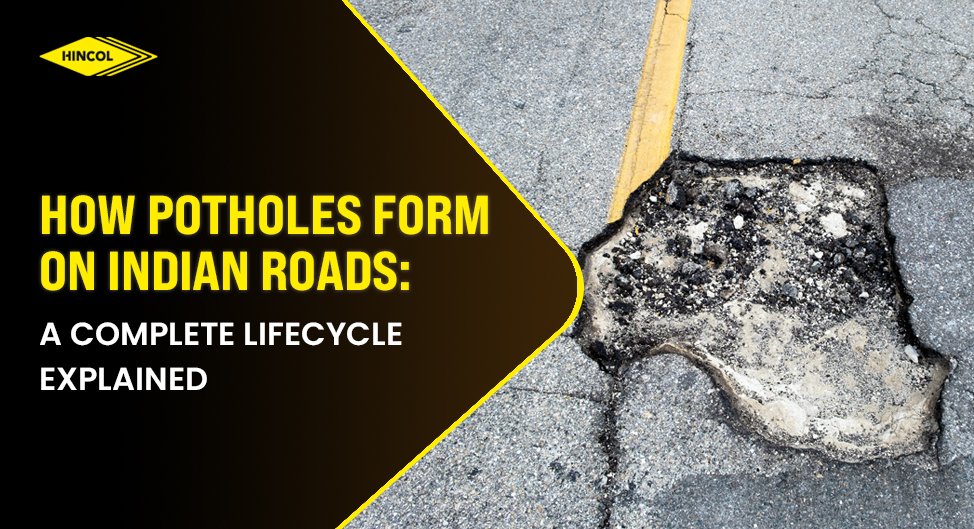
How Potholes Form on Indian Roads: A Complete Lifecycle Explained
Road potholes claim thousands of lives in India each year, with in pothole-related accidents in 2022 alone. We encounter these dangerous hazards daily on our commutes, yet few of us understand how they evolve from minor cracks into deadly threats.
What are potholes, exactly, and how are potholes formed? These depressions in road surfaces represent more than just inconveniences. According to the American Automobile Association, potholes cost drivers approximately in vehicle repairs. Furthermore, a study by IIT Madras found that nearly 78% of urban potholes reported by citizens remain unfixed for more than two weeks. This persistent problem on Indian roads affects everyone from pedestrians to motorists.
In this article, we’ll examine the complete lifecycle of road potholes problems—from the initial surface cracks to their expansion into full-fledged hazards. By understanding how these destructive features develop, we can better appreciate why timely intervention is crucial and how proper road maintenance might save both lives and resources.
Stage 1: How surface cracks begin on Indian roads
Surface cracks represent the first stage in the lifecycle of road potholes. These seemingly minor imperfections serve as early warning signs of more significant road deterioration to come.
Weather extremes and thermal expansion
India’s diverse climate subjects roads to severe , creating ideal conditions for crack formation. During hot summer months, asphalt softens considerably, making it more malleable but simultaneously more vulnerable to deformation under heavy traffic. As temperatures rise, the bitumen in road surfaces oxidizes more rapidly, becoming brittle and developing microscopic cracks.
Conversely, as temperatures drop, asphalt contracts and becomes stiffer. This thermal contraction generates tensile stresses within the pavement material, leading to transverse cracking across the road width. Such cracks, though initially invisible to the naked eye, provide entry points for water and other elements that accelerate road deterioration.
Heavy traffic and overloaded vehicles
The impact of vehicle loads, especially from overloaded commercial vehicles, significantly accelerates crack formation on Indian roads. Research indicates that , while 30% overloading decreases lifespan by a staggering 65%. In fact, one in three trucks in India exceeds its maximum load capacity, contributing to about 50% of all traffic collisions.overloading trucks by just 10% reduces pavement life by approximately 35%
The damage follows an exponential relationship known as the “fourth power law” – a vehicle with twice the legal axle load can cause 16 to 60 times more damage than a standard axle. Additionally, studies show that for every 1% increase in overweight trucks, there’s a corresponding 1.8% reduction in pavement service life.
Poor quality materials and construction gaps
Many initial cracks stem from substandard construction materials and practices. Field evidence reveals that roads often fail within 2-3 years instead of their designed 15-20 year lifespan due to poor adherence to construction standards.
The use of inferior materials is often linked to corruption in the construction process. In some regions, contractors are reportedly forced to pay kickbacks reaching up to 40% of the contracted amount, leaving insufficient funds for quality materials. For instance, instead of using proper emulsions to help bitumen adhere to road layers, contractors might substitute cheaper alternatives like kerosene, significantly compromising road durability.
Stage 2: Water seeps in and weakens the base
Once surface cracks appear, they become gateways for water infiltration—marking a critical phase in road potholes development. Water access accelerates deterioration by undermining the structural integrity of the road’s foundation.
Monsoon impact and poor drainage
The monsoon season poses an existential threat to Indian roadways. Heavy downpours overwhelm roads, with rainwater penetrating cracks in the pavement and soaking the granular layers beneath the asphalt. Unfortunately, remain a primary cause of repeated road damage during these seasonal rains.poor drainage systems
Many urban areas struggle with inadequate drainage infrastructure. Stormwater drains are frequently narrow, clogged, or poorly designed, allowing water to stagnate along pavement edges. This situation is particularly evident in market areas which typically lack sufficient drainage facilities. As a result, stagnant water on road surfaces causes rapid deterioration of bituminous layers through stripping—a process where water separates bitumen from the aggregate surface.
Subsurface erosion and hidden voids
Once water infiltrates beneath the surface, it initiates a destructive chain reaction. Moisture steadily weakens the pavement’s foundation by reducing the bearing capacity of the soil. Over time, this persistent erosion enlarges channels beneath the road, forming mini gorges and hollows.
The most concerning aspect is the development of hidden voids—empty spaces that form as water gradually washes away subsurface material. These voids can reach alarming dimensions before becoming visible; one documented case revealed a and 2 meters deep caused by water leakage from an underground pipe.void approximately 5 meters in diameter
Why early signs are often missed
Early warning indicators of subsurface deterioration exist but typically go unnoticed until visible damage appears. Subtle signs include:
- Localized soft areas near existing cracks
- Small valley-like depressions forming around damaged sections
- Slight discoloration indicating moisture retention
Moreover, the subsurface nature of this process makes pipes and voids particularly difficult to detect with standard visual inspections. Since they remain invisible until a roof collapse occurs, problems continue unaddressed for extended periods.
Road authorities often lack proper monitoring systems to track weather-related damage effectively. Without specialized equipment like ground-penetrating radar (GPR), which can detect subsurface anomalies, these hidden deterioration zones continue expanding until they finally manifest as full-fledged potholes in roads.
Stage 3: Pothole formation and rapid expansion
When the weakened road structure finally gives way, a true pothole emerges. This critical transition marks the point where invisible damage becomes a tangible hazard for all road users.
Collapse of weakened surface
The actual formation of road potholes occurs when the road surface over a compromised foundation suddenly collapses under pressure. This collapse happens because subsurface erosion creates hidden voids beneath seemingly intact pavement. Initially, these failures appear as shallow depressions, yet they rapidly deteriorate into dangerous craters that endanger vehicles and pedestrians alike.
How potholes grow during rainy seasons
Throughout monsoon periods, potholes in roads expand at alarming rates. Poor drainage systems have consistently been the greatest weakness of Indian road infrastructure, causing premature pavement failure through cracks, settlement, and rutting.
Subsequently, the newly formed potholes trap more water, creating a destructive cycle where each rainfall further damages the road structure. As the pavement begins to dry after heavy rains, the full extent of damage becomes visible, with new potholes suddenly appearing across affected areas. Recent documentation shows craters forming on roads in various Indian cities specifically because of monsoon rains.
Role of repeated vehicle pressure
Vehicle traffic, although not the initial cause, serves as the final catalyst in turning weakened pavements into full-blown road potholes problems. The constant impact of tires, particularly from heavy trucks, accelerates the collapse process. One in three trucks in India exceeds maximum load limits, with overloaded vehicles contributing to 50% of all traffic collisions.
Each passing vehicle removes loose bits of asphalt, gradually widening the damaged area. This process helps explain why indian road potholes killed 3,597 people in 2017 alone—approximately 10 lives daily.
Stage 4: When potholes become a public hazard
Potholes transform from mere road defects into public safety hazards when they begin threatening lives and damaging vehicles. Unfortunately, their impact extends beyond inconvenience to become deadly traps for unwary travelers.
Risks to two-wheelers and pedestrians
Two-wheeler riders face disproportionate danger from road potholes, accounting for 45% of all road fatalities in India. The spine becomes the first casualty as riders navigate uneven surfaces—many orthopedic doctors report seeing doubled cases of spine injuries after rainy seasons. Indeed, a staggering 90% of fatal two-wheeler accidents in Delhi were linked to uneven road surfaces. Pedestrians remain equally vulnerable, comprising 20.4% of all road fatalities. Notably, in cities like Bengaluru, three pedestrians are killed every two days by traffic, often while trying to navigate poor road conditions.
Accidents in high-speed or low-visibility zones
The danger of potholes in roads multiplies dramatically under specific conditions. Dimly lit stretches present invisible hazards—small potholes on busy highways prove deadlier than larger ones on quiet streets. Remarkably, rainy-day crashes claimed 13,734 lives in 2023 alone, with poor road conditions as a major contributor. These accidents peak between 6-9 PM when visibility decreases. Typically, potholes filled with rainwater become stagnant pools where depth remains imperceptible, creating perfect conditions for accidents.
Economic cost of delayed repairs
The economic toll of indian road potholes is staggering. Road accidents cost India approximately 3% of its GDP annually. Nonetheless, the World Bank estimates traffic congestion leads to economic losses of 2-5% of GDP. Consequently, poor road conditions cost the Indian economy over Rs 30,000 crore annually in lost productivity and vehicle damage. Close to 2.5 lakh cars suffer damage yearly due to bad roads, with repair costs ranging from Rs 10,000-30,000 per vehicle.
Conclusion
Understanding the lifecycle of potholes gives us valuable insight into why our roads deteriorate so rapidly. From initial surface cracks to full-blown hazards, each stage represents a missed opportunity for intervention. Weather extremes, substandard materials, and monsoon rains work together to create these dangerous road depressions that claim thousands of lives yearly.
Undoubtedly, prevention costs far less than repair. Early detection and timely maintenance could save billions in economic losses while protecting countless lives, especially vulnerable road users like two-wheeler riders and pedestrians. Poor road conditions affect everyone – from daily commuters facing vehicle damage to the national economy losing billions through decreased productivity and accident costs.
Therefore, addressing this issue requires a multi-faceted approach. Better quality materials, improved construction standards, and efficient drainage systems must become priorities. Additionally, regular monitoring with advanced technologies like ground-penetrating radar could help identify subsurface weaknesses before they develop into dangerous craters.
The pothole problem ultimately reflects broader infrastructure challenges across India. Though seemingly minor annoyances, these road defects represent significant public safety hazards with real economic and human costs. Road safety deserves attention not just during monsoons but year-round through consistent maintenance and improved construction practices. After all, smooth, safe roads benefit everyone – drivers, pedestrians, and the economy alike.
Key Takeaways
Understanding how potholes develop helps explain why Indian roads deteriorate so rapidly and why prevention is crucial for saving lives and money.
• Potholes follow a predictable 4-stage lifecycle: surface cracks from weather/traffic → water infiltration weakening foundations → sudden collapse under pressure → rapid expansion into deadly hazards
• Prevention costs far less than repair: Early detection and timely maintenance could save billions in economic losses while protecting the 3,625+ lives lost annually to pothole accidents
• Overloaded trucks accelerate road damage exponentially: Just 10% overloading reduces pavement life by 35%, while one-third of Indian trucks exceed legal weight limits
• Monsoon seasons create perfect storm conditions: Poor drainage systems allow water to penetrate cracks, erode foundations, and rapidly expand existing potholes during heavy rains
• Two-wheeler riders face disproportionate danger: They account for 45% of road fatalities, with 90% of fatal accidents in Delhi linked to uneven road surfaces
The economic impact is staggering—road accidents cost India 3% of GDP annually, while poor road conditions alone cause over ₹30,000 crore in lost productivity. Better construction standards, improved drainage, and regular monitoring with advanced technologies could transform this deadly cycle into preventable maintenance issues.
Read also : What is cold mix technology and its use in road construction
FAQs
Q1. How do potholes initially form on Indian roads? Potholes typically start with small surface cracks caused by weather extremes, heavy traffic, and poor-quality materials. These cracks allow water to seep in, especially during monsoons, weakening the road’s foundation. Over time, the weakened surface collapses under pressure from vehicles, creating a pothole.
Q2. Why are potholes so prevalent in India? Several factors contribute to the prevalence of potholes in India, including extreme weather conditions, inadequate drainage systems, overloaded vehicles, and substandard construction practices. The use of poor-quality materials and lack of timely maintenance also exacerbate the problem, especially in urban areas.
Q3. How quickly can potholes expand during the rainy season? Potholes can expand rapidly during monsoons. Poor drainage causes water to accumulate in existing cracks and holes, further weakening the road structure. Each rainfall can significantly worsen the damage, with new potholes suddenly appearing across affected areas as the pavement dries after heavy rains.
Q4. What makes potholes particularly dangerous for two-wheeler riders? Two-wheeler riders are at high risk from potholes because they have less stability and protection compared to four-wheeled vehicles. Hitting a pothole can cause loss of control, leading to accidents. In fact, 45% of all road fatalities in India involve two-wheeler riders, with many accidents linked to uneven road surfaces.
Q5. What is the economic impact of potholes in India? The economic toll of potholes in India is substantial. Road accidents, many caused by poor road conditions, cost the country approximately 3% of its GDP annually. Additionally, traffic congestion due to bad roads leads to economic losses of 2-5% of GDP. Vehicle damage from potholes costs billions in repairs, with repair costs ranging from Rs 10,000-30,000 per affected vehicle.