
Where Does Bitumen Come From? The Complete Story Behind This Ancient Material
Have you ever driven on a smooth highway and wondered what makes it strong and waterproof? The answer is bitumen — a thick, dark, sticky material that holds roads together. But where does bitumen come from, exactly?
Whether you are a road engineer, a student, or simply curious, this article gives you the full picture. We cover its natural origins, how it is made from crude oil, and why India’s road network depends on it every day.
What Is Bitumen?
Bitumen is a dark, viscous hydrocarbon material. It is semi-solid at room temperature and becomes fluid when heated.
The word “bitumen” comes from the Sanskrit word jatu, meaning pitch. The Latin form bitumen was later adopted across Europe. It eventually became the global technical term for this material.
In common usage, especially in North America, bitumen is often called asphalt or asphalt cement. In India, road engineers use both terms depending on context.
Bitumen is primarily made of carbon and hydrogen atoms. It also contains small amounts of sulfur, nitrogen, and oxygen. This unique chemistry gives it:
- Excellent waterproofing properties
- High durability under traffic loads
- Strong binding capacity for road aggregates
- Resistance to acids, alkalis, and UV light
Where Does Bitumen Come From? Two Primary Sources
Bitumen comes from two main sources: natural deposits and crude oil refining.
Both forms have been used throughout history. Today, however, the vast majority of bitumen used in road construction worldwide comes from petroleum refining.
1. Natural Bitumen (Crude Source)
Natural bitumen — also called crude bitumen or native bitumen — forms over millions of years underground.
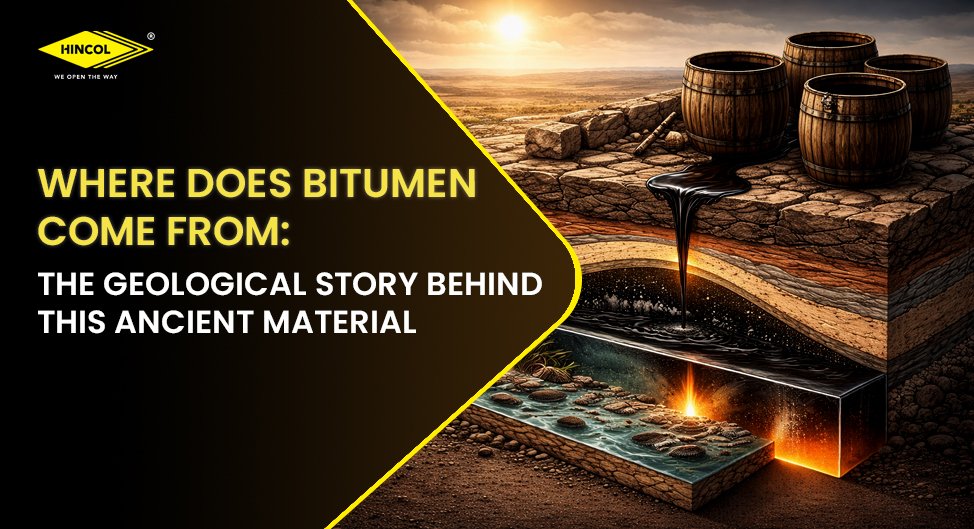
It originates from the same geological process that creates crude oil. Ancient marine organisms such as algae, plankton, and small sea creatures died and settled on the ocean floor. Over time, heat and pressure deep within the earth transformed these organic materials into hydrocarbons.
When these hydrocarbons migrated to the surface — or close to it — and the lighter fractions evaporated due to weathering, the heavier residue was left behind. That heavy residue is natural bitumen.
Key natural bitumen deposits worldwide include:
- Athabasca Oil Sands, Canada — the world’s largest natural bitumen reserve, holding an estimated 1.7 trillion barrels of bitumen in place (Source: NASA Earth Observatory / Alberta Energy Regulator)
- Pitch Lake, Trinidad & Tobago — the world’s largest natural asphalt lake, covering approximately 40 hectares (100 acres) (Source: Encyclopaedia Britannica)
- Dead Sea region (Middle East) — used by ancient civilisations for thousands of years
- Val-de-Travers, Switzerland — historically important for early road construction in Europe
Natural bitumen is typically mixed with sand, clay, and water. It must be processed before it can be used in road construction.
2. Petroleum-Derived Bitumen (Refined Source)
Today, most bitumen is derived from crude oil through a refining process. This is the source of virtually all bitumen used in India’s road construction industry.
Crude oil is a complex mixture of hydrocarbons. When refineries process crude oil, they separate it into various components using a process called fractional distillation.
The crude oil is heated to very high temperatures in a distillation column. Different components — called fractions — boil off at different temperatures and are collected separately:
- Petroleum gas (lightest fraction)
- Petrol / gasoline
- Kerosene
- Diesel
- Lubricating oil
- Bitumen (heaviest fraction — collected at the bottom)
Bitumen is the heaviest and least volatile component of crude oil. It stays at the bottom of the distillation column after all lighter fractions have been removed.
After primary distillation, the residual material goes through a further process called vacuum distillation or air blowing to produce bitumen with specific properties for different applications.
How Is Bitumen Made Step by Step?
Understanding how bitumen is made helps you appreciate the precision involved in producing road-grade material.
Step 1 — Crude Oil Selection
Not all crude oils produce good-quality bitumen. Refiners carefully select crude oil types — often from the Middle East, Venezuela, or Canada — based on their bitumen yield and quality.
Step 2 — Atmospheric Distillation
Crude oil is heated to around 350°C in an atmospheric distillation unit. Lighter fractions like petrol, kerosene, and diesel are separated and collected. A heavy residue remains. (Source: Encyclopaedia Britannica — Petroleum Refining)
Step 3 — Vacuum Distillation
The heavy residue is further processed under vacuum at lower temperatures — typically around 75–100°C lower than atmospheric distillation temperatures. This removes more light fractions without cracking the bitumen molecules.
The output is called Vacuum Residue or Short Residue — the raw material for road-grade bitumen.
Step 4 — Air Blowing (Optional)
For some grades, the vacuum residue is treated by blowing air through it at high temperatures. This process oxidises the bitumen, making it harder and more suitable for specific applications such as roofing or modified bitumen grades.
Step 5 — Quality Testing and Grading
Finished bitumen is tested extensively. Key tests include:
- Penetration test — measures hardness (deeper penetration = softer grade)
- Softening Point test — temperature at which bitumen softens
- Ductility test — measures elasticity
- Viscosity test — measures flow at a specified temperature
In India, bitumen is graded under IS 73:2013 as VG10, VG20, VG30, and VG40 — based on viscosity. (Source: Bureau of Indian Standards). VG30 is the most commonly used grade for road construction across most of India.
A Brief History of Bitumen
Bitumen is one of the oldest construction materials known to humanity. Its story goes back more than 3,000 years. (Source: Encyclopaedia Britannica)
Ancient Uses
The earliest recorded use of bitumen dates to ancient Mesopotamia — modern-day Iraq. Historical accounts describe how bitumen was used as a mortar to bond the brick walls of ancient Babylon.
Around the same period, Middle Eastern civilisations used bitumen for:
- Waterproofing boats and baskets
- Caulking the hulls of ships
- Binding decorative tiles on temple walls
- As an adhesive and sealant
Herodotus, the ancient Greek historian, recorded that the rulers of Persia and Babylon actively used bitumen in large-scale construction projects. Archaeological evidence confirms bitumen use at sites across the Dead Sea, Egypt, and the Indus Valley region — including in what is now Pakistan and northwest India.
Bitumen in the Americas
Indigenous peoples of North America also discovered natural bitumen independently. The Tongva, Chumash, and Luiseño peoples of California used natural bitumen deposits as an adhesive from at least the 13th century — waterproofing canoes and attaching tools. (Source: Encyclopaedia Britannica)
The Road-Building Revolution
Bitumen as a road material came much later. In 18th-century England, engineer John Metcalf laid approximately 180 miles (290 km) of improved roads in Yorkshire — among the earliest recorded bituminous road construction in Britain. (Source: Encyclopaedia Britannica)
Thomas Telford extended this approach across Scotland. The real turning point came when Scottish engineer John Loudon McAdam refined the process — mixing crushed stone with bituminous material to create a stronger road surface. This material became known as tarmacadam — later shortened to tarmac — a term still widely used today.
In the United States, Belgian-American chemist Edward de Smedt developed the first refined petroleum-derived bitumen for road paving in the 1870s. His formula was used to resurface Washington D.C.’s Pennsylvania Avenue. By 1907, petroleum-derived bitumen had almost completely replaced natural bitumen for road construction in the US. (Source: Eurobitume)
Natural Bitumen vs Petroleum-Derived Bitumen
| Feature | Natural Bitumen | Petroleum-Derived Bitumen |
|---|---|---|
| Source | Underground geological deposits | Crude oil refining |
| Purity | Mixed with sand, clay, minerals | High purity — controllable |
| Consistency | Variable by deposit | Consistent and graded |
| Cost | Higher (extraction + processing) | Lower at scale |
| Availability | Limited geographic locations | Globally available |
| Primary use today | Specialty applications | Road construction |
Today, petroleum-derived bitumen accounts for over 95% of global bitumen consumption. (Source: Eurobitume — European Bitumen Association)
Where Does Bitumen Come From in India?
India is one of the world’s largest consumers of bitumen, given its massive road infrastructure programme.
India’s bitumen is sourced from two channels:
1. Domestic refineries Indian refineries — including those operated by HPCL, BPCL, IOCL, and others — produce bitumen as a by-product of crude oil processing. India has significant refinery capacity, and domestic production meets a substantial portion of national demand.
2. Imports India also imports bitumen — particularly from Middle Eastern countries such as Saudi Arabia and the UAE — to meet demand peaks and specific grade requirements.
Bitumen manufacturers like HINCOL (Hindustan Colas Limited) — a joint venture of Hindustan Petroleum Corporation Ltd. and COLAS SA, France — play a key role in processing, quality-assuring, and supplying bitumen emulsions and modified bitumen products across Indian highway projects.
What Is Bitumen Used For?
Bitumen’s properties make it indispensable across multiple industries. Its primary application globally is road construction — but its uses extend far beyond roads.
Road Construction (primary use)
- Dense Bituminous Macadam (DBM) layers
- Bituminous Concrete (BC) wearing courses
- Tack Coat — bonding layers together (internal link)
- Prime Coat — sealing granular base layers
- Surface Dressing / Chip Seal
Waterproofing
- Roofing felt and membranes
- Underground structure waterproofing
- Bridge deck waterproofing
- Canal and reservoir lining
Industrial Applications
- Sound insulation in vehicles
- Electrical cable coatings
- Corrosion protection for pipelines
- Anti-rust coatings for metals
Types of Bitumen Products Used in Road Construction
Modern road construction uses several refined bitumen products, each designed for specific conditions:
Viscosity Grade (VG) Bitumen — standard road bitumen graded by viscosity (VG10, VG20, VG30, VG40 as per IS 73:2013)
Polymer Modified Bitumen (PMB) — bitumen blended with polymers like SBS or EVA for improved performance on high-traffic or high-temperature roads (internal link)
Crumb Rubber Modified Bitumen (CRMB) — bitumen modified with recycled tyre rubber — more durable and reduces road noise
Bitumen Emulsions — bitumen dispersed in water with an emulsifier, applied at ambient temperature without heating. Used for tack coat, prime coat, slurry seal, and fog seal. Produced by HINCOL in grades including RS1, SS2, CRS2P, and many more.
Cutback Bitumen — bitumen dissolved in petroleum solvent for cold-weather applications. Being phased out in favour of eco-friendly emulsions.
Why Bitumen Quality Matters for India’s Roads
According to the Ministry of Road Transport and Highways (MoRTH), India’s total road network spans over 6.6 million kilometres — the second largest in the world. (Source: MoRTH, Government of India)
The quality of bitumen directly determines how long roads last under India’s challenging conditions: extreme temperatures, heavy monsoon rains, overloaded trucks, and high traffic volumes.
Poor quality bitumen leads to:
- Rutting — permanent deformation in wheel tracks
- Cracking — thermal and fatigue cracks
- Stripping — loss of bond between bitumen and aggregate
- Bleeding — excess bitumen rising to the surface
Using the right bitumen grade, correctly tested and applied, is essential. Organisations like HINCOL ensure every batch of bitumen meets strict IS standard requirements — protecting India’s road investment for decades.
Frequently Asked Questions (FAQ)
Q1. Where does bitumen come from naturally?
Natural bitumen comes from geological deposits where ancient organic material — mostly marine organisms — was transformed by heat and pressure over millions of years. The lighter hydrocarbons evaporated, leaving the heavy bituminous residue. According to NASA Earth Observatory, the largest natural bitumen deposit is in Canada’s Athabasca Oil Sands, holding an estimated 1.7 trillion barrels. Pitch Lake in Trinidad is the world’s largest natural asphalt lake, covering approximately 40 hectares.
Q2. Is bitumen the same as crude oil?
No. Bitumen is derived from crude oil but is not the same thing. Crude oil is a mixture of many hydrocarbons of different molecular weights. Bitumen is the heaviest fraction — what remains after lighter products like petrol, diesel, and kerosene are removed during refining. You can think of bitumen as the “bottom of the barrel” of crude oil.
Q3. How is bitumen made from crude oil?
Bitumen is made by heating crude oil in a distillation column to around 350°C. Lighter fractions boil off at different temperatures and are collected. The heaviest residue — bitumen — remains at the bottom. It then goes through vacuum distillation to remove more light fractions, producing road-grade bitumen with specific properties.
Q4. What is the difference between natural bitumen and petroleum bitumen?
Natural bitumen is found in geological deposits mixed with sand, clay, and minerals. It requires extensive processing before use. Petroleum bitumen is produced by refining crude oil. It is purer, more consistent in quality, cheaper to produce at scale, and available globally. According to Eurobitume, over 95% of all bitumen used in road construction worldwide is petroleum-derived.
Q5. What is bitumen used for in India?
In India, bitumen is primarily used for road construction — as a binder in Dense Bituminous Macadam, Bituminous Concrete, tack coat, prime coat, and surface dressing. It is also used for waterproofing roofs, bridges, and underground structures. India uses predominantly VG30 grade bitumen for most highway applications, as per IS 73:2013 standards set by the Bureau of Indian Standards.
Conclusion
Bitumen has a remarkable story. It starts millions of years ago — with tiny sea creatures whose remains were slowly transformed underground by heat and pressure.
Today, that same material is refined from crude oil and applied across India’s 6.6 million kilometre road network every year. It keeps vehicles moving, waterproofs structures, and protects infrastructure from India’s extreme climate.
Understanding where bitumen comes from — and how it is made — helps road engineers, contractors, and policymakers make better decisions about the materials they use.
Whether it is standard VG30 for a national highway, a polymer-modified grade for an expressway, or a bitumen emulsion for maintenance and stabilisation — the source story of bitumen is the foundation of modern road engineering.
Want to know more about India’s bitumen products? Explore HINCOL’s full range of bitumen emulsions — from tack coat to stabilisation grades — manufactured to IS 8887 standards and backed by global expertise. 👉 Explore HINCOL Bitumen Emulsions